This guide offers general preparation recommendations. Specific procedures from your energy provider, as well as medical instructions for individuals dependent on electrical equipment, may vary: always verify with the official source in your city or country.
Initial Summary
If the power goes out in your home, your building, or the entire neighbourhood, this guide helps you know what to do at every stage: before it happens, while the power outage lasts, and as soon as the energy returns. You will also find how to look after your food, what to do with your devices, what to keep in a basic kit, what to ask when the outage is recurrent, and which mistakes to avoid.
Quick Response: If the Power Just Went Out
- Check if the outage is only in your home or the entire sector (see if your neighbours are also without light or check your building or residential complex's WhatsApp group).
- Use a flashlight, not a candle, as your first option.
- Do not open the fridge or freezer unless absolutely necessary.
- Disconnect sensitive electronic equipment (computer, television, router).
- If there are children, elderly adults, or pets at home, place them in a familiar and calm space.
- If you need to pay for something, keep some cash on hand: some card terminals and digital wallets may fail while there is no power or internet in the area.
- Keep calm: most power outages are resolved within minutes or hours.
When the Power Goes Out, the First Step Is Not to Improvise
It’s seven in the evening, you’re finishing cooking or in the middle of a work video call, and suddenly everything goes dark. The fridge stops humming, the router turns off, and the house falls silent.
Most power outages in Colombia and Latin America last for a short time and are due to service failures, scheduled maintenance, or heavy rains affecting the electrical grid. In some countries in the region, there are also periods of scheduled power outages or rationing, decreed by authorities during service shortages; in those cases, in addition to what you see here, it is advisable to check the official calendar or notices from your energy provider directly.
The idea is not to live in fear, but to reduce improvisation: knowing what to do first, what to avoid, and what to have at hand makes those minutes or hours much more manageable, whether you live alone in an apartment, in a house with children, with elderly adults, with pets, or if you depend on a connection to work from home.
What to Do Before a Power Outage
Preparing doesn't mean filling your house with equipment. It means being clear about where the basic items are and how to react when the power goes out.
- Keep a flashlight handy in a fixed place that the whole family knows (nightstand, entrance drawer, kitchen).
- Keep a charged power bank. It doesn't need to be high-end, but it must have a charge when you need it.
- Identify where the breakers or fuses are in your home. If you live in a residential complex, also locate the machine room or the administration contact to report failures.
- Save your energy provider's customer service line in a visible place, along with the number for the security gate, a trusted neighbour, or a close relative. A piece of paper stuck to the fridge helps more than it seems when your mobile loses signal or battery.
- Have some water available, especially if in your area power outages also affect the water supply due to reliance on an electric pump.
- Think about who needs the most attention in your home: babies, elderly adults, people with reduced mobility, people using electrical medical equipment, or pets that get agitated by noise or darkness.
- If you work from home or run your own business, define a Plan B in advance: where you can connect if the outage is extended (a café with a generator, a relative’s house) and how to notify people in time if you are going to miss a deadline.
- Assemble a small kit with the essentials (see full details below).
Nexo Tip: You don't need to buy everything at once. Start with a flashlight, water, and a power bank. You can complete the rest calmly over time.
What to Do During a Power Outage
This is the moment where having clarity helps most, because it’s when you least feel like thinking.
- Keep calm. Most outages are resolved within a reasonable timeframe.
- Check if the outage is only yours or sector-wide. See if the neighbours are also without light, if streetlights or traffic lights are out, or ask in your building or neighbourhood group. This helps you know if it’s a specific issue in your home (e.g., a tripped breaker) or a more general outage.
- Use flashlights instead of candles. A flashlight does not produce fire or smoke and reduces the risk of accidents, especially if children or pets are moving around the house.
- Disconnect sensitive equipment such as computers, televisions, routers, or consoles to protect them from potential voltage fluctuations when the power returns.
- Do not open the fridge or freezer unnecessarily. Every opening lets out the accumulated cold and reduces the time food stays in good condition.
- Do not use electrical generators inside the house, in closed garages, or near windows. Organisations like FEMA and the CDC in the United States recommend using them only outdoors, far from doors and windows, due to the risk of carbon monoxide poisoning.
- Look after the most vulnerable people in the home: offer company to an elderly adult, keep pets in a familiar space, and if someone depends on electrical medical equipment, check if it has a backup battery or if you need to activate your alternative plan, such as going to a healthcare centre.
- Avoid electrical risks: do not touch sockets or cables if there is moisture, and do not manipulate the electrical panel if you are not sure what to do.
Quick action: Flashlight on, sensitive equipment disconnected, fridge closed. With these three steps, you already reduce a large part of the risk.
How to Protect Food During a Power Outage
Food is one of the biggest concerns when the power is out for several hours. The key is to open the fridge and freezer as little as possible.
- Keep the fridge closed as much as you can.
- Keep the freezer closed. A well-sealed freezer retains cold much longer than a fridge.
- Do not taste food if you have doubts about its condition. Smell or appearance are not always enough to know if something is still safe.
- If in doubt about a perishable food item, it is better to discard it than to take the risk.
As a general reference —based on food safety recommendations from the US CDC— and provided the fridge and freezer remain closed:
| Equipment | Approximate Time |
|---|---|
| Closed Fridge | Up to 4 hours |
| Full Freezer | Up to 48 hours |
| Half-full Freezer | Up to 24 hours |
These times vary depending on ambient temperature, how many times the door is opened, and how full the unit is, so take them as a general guide rather than an exact rule.
To keep in mind: A full freezer stays cold longer than one with little content because the food items act as a sort of cold block for each other.
What to Do When the Power Returns
The return of power also has its own order. Connecting everything at once is not the best idea.
- Wait a few minutes before reconnecting everything. This helps the grid stabilise, especially after long outages or storms.
- Check for strange smells, sparks, moisture, or sockets that feel hot before using outlets normally.
- Connect equipment gradually, not all at once. Start with the most important items (fridge, router) and continue with the rest.
- Check the condition of food in the fridge and freezer, using the reference times from the previous section as a guide.
- Recharge the devices you used during the power outage: flashlight, power bank, mobile phone.
- Replenish what you used from the kit, such as batteries or water, to be ready for the next time.
Avoid this: Connecting the fridge, television, computer, microwave, and air conditioning all at the same time the moment the power comes back. Spacing out connections reduces the risk of overloads.
Basic Power Outage Kit
You don't need to have a house full of equipment, but you do need some basic elements organised in a single place, easy to find even in the dark.
Minimum Kit
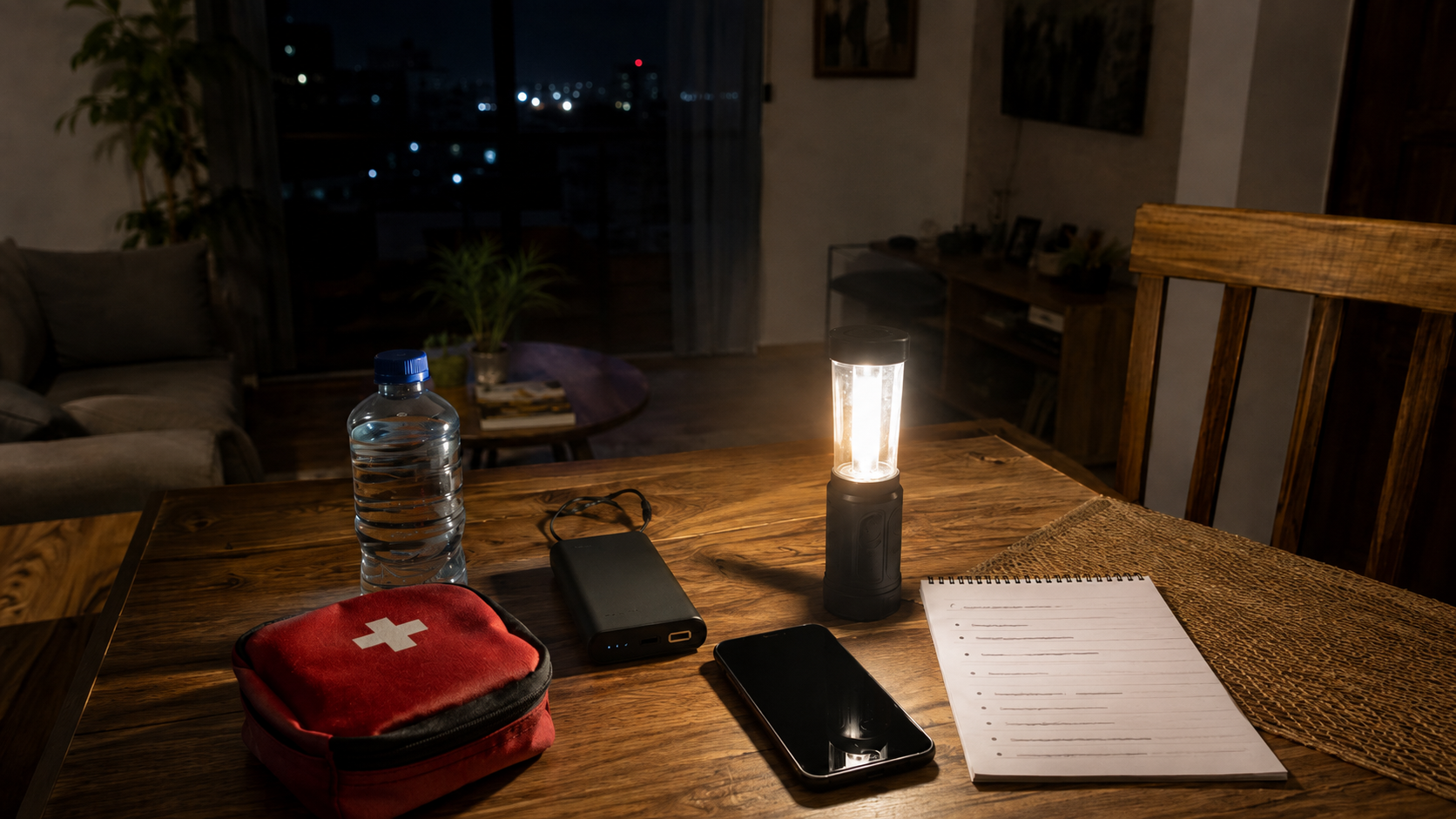
- Flashlight.
- Spare batteries or a way to recharge it.
- Power bank.
- Water.
- List of important contacts (on paper or saved without depending on internet).
Recommended Kit
- Portable radio (battery-powered or hand-cranked).
- Basic first aid kit.
- LED table or area lamp.
- Whistle, useful in case of an emergency inside a building.
- Some cash, in case electronic payment systems or digital wallets fail along with the power.
- Copies of important documents in an accessible place.
Kit for Households with Special Needs
- Regularly used medications, with a few days' margin.
- Baby items: nappies, formula, something to heat them without relying on electricity if possible.
- Pet items: food, leash, something to help them feel calm.
- A clear plan for people who depend on any electrical medical equipment: who to call, where to go, and whether there is a backup battery. This plan should be defined with the treating physician, not improvised.
Common Mistakes During a Power Outage
- Opening the fridge "just to look" several times during the outage.
- Using candles unsupervised, especially near curtains, papers, or with children or pets nearby.
- Connecting all equipment at the same time as soon as the power returns.
- Using generators inside the house or in closed spaces.
- Ignoring a burning smell, sparks, or strange noises in the electrical panel.
- Relying solely on a mobile phone as a flashlight, without considering that it can also run out of battery.
- Not having any important contact numbers saved outside the internet.
- Leaving the house without cash, assuming that all digital payments will work normally without power or data in the area.
Items That Can Help You Be Better Prepared
This article may contain affiliate links. If you access a resource through these links, Nexo Práctico might receive a commission at no additional cost to you. This does not change our editorial criteria.
You’ve seen what your kit should contain based on your household type. If you notice you’re missing something specific, here we explain what each item is for and what to check before buying it, without needing to replace everything you already have.
Rechargeable Flashlight Serves as the primary light source during an outage, without relying on batteries that run out at the worst possible moment. It is useful in any household, especially if there are children or elderly adults who need to move safely in the dark. Before buying, check how long the charge lasts and if it has solar or USB charging options.
Power Bank Allows you to keep your mobile phone battery charged for communication or for use as a backup flashlight. It is especially useful if you work from home or if you need to be available for work or health reasons. Check its capacity and how many times it can charge a phone before running out.
Portable Radio Helps keep you informed about what is happening, especially during long outages where mobile phones may lose signal or data. It is useful in homes with elderly adults or in areas where outages tend to be extended. Before buying, check if it works with batteries, manual charging, or both.
LED Lamp Provides broader light than a flashlight, useful for lighting a whole room while cooking, studying, or attending to someone. It is practical in houses and apartments where several people share the same space during the power outage. Check its battery life and if it can be easily recharged.
First Aid Kit Having basic first aid items on hand reduces improvisation if a bump, a minor burn, or any unexpected event occurs during the darkness. It is useful in any home, especially where there are children or elderly people. Before buying, check what items are included and if it fits your family's needs.
Waterproof Document Organiser Used to keep copies of important documents at hand, protected from moisture, especially if power outages in your area often coincide with heavy rain. It is useful in homes that want to have everything organised in one place. Check the size and if the material is truly water-resistant.
Voltage Protector Helps protect sensitive electronic equipment from sudden energy variations, both during the outage and when power returns. It is useful in homes with computers, televisions, or expensive appliances. Before buying, check its capacity and what type of equipment it can protect.
No item on this list is mandatory, nor does it completely eliminate the risks of a power outage. The idea is to choose what makes sense for how you live, not to feel like you need to have it all.
Quick Checklist for a Power Outage
- [ ] Flashlight located in a fixed place known to everyone at home.
- [ ] Power bank charged.
- [ ] Water available.
- [ ] Your energy provider's number and important contacts saved without depending on internet.
- [ ] Clear location of breakers or fuses.
- [ ] Plan for elderly adults, babies, pets, or people with medical equipment.
- [ ] Basic kit assembled and in one place.
- [ ] Some cash available.
- [ ] Electronic equipment disconnected during the outage.
- [ ] Fridge and freezer closed for as long as possible.
- [ ] Gradual reconnection of equipment when the power returns.
Frequently Asked Questions
How long does food last in the fridge without power? According to general food safety recommendations from the US CDC, a closed fridge maintains a safe temperature for up to 4 hours. A full freezer can last up to 48 hours and a half-full one up to 24 hours, provided they remain closed. These times vary based on ambient temperature and how many times the door is opened.
Is it safe to use candles during a power outage? They can be used, but flashlights should be prioritised whenever possible. If you decide to use candles, never leave them unattended, keep them away from curtains or papers, and keep them out of reach of children and pets.
Should I disconnect appliances? It is advisable to disconnect the most sensitive electronic equipment (computer, television, router) to protect them from potential voltage variations, both during the outage and when power returns.
Can power outages damage my appliances? An outage itself does not usually damage equipment, but the voltage spikes that sometimes occur when power returns can affect them. That is why it is best to disconnect sensitive equipment during the power outage and reconnect them gradually, not all at once.
Can I cook with a gas stove if the power goes out? In many homes in the region, gas stoves continue to work without electricity, but it depends on the model: some require electric ignition. If your stove does work without light, ventilate the space well while cooking.
What happens to the water if it depends on an electric pump? If your building or home uses an electric pump to pull water up, it is likely that the supply will also be affected during the power outage. Therefore, it is advisable to always have some stored water as part of your basic kit.
What are scheduled power outages and how do they differ from a failure? A scheduled power outage is a cut announced in advance by authorities or the energy provider, generally due to service shortages, and usually follows a known schedule or calendar. A failure, on the other hand, occurs without prior notice due to grid damage, overloads, or weather conditions. If there are scheduled power outages in your country, it is worth checking the official calendar in addition to following this guide.
What should a basic power outage kit contain? At minimum: a flashlight, batteries or a charged power bank, water, and a list of important contacts saved without depending on internet. From there, you can add items according to your household.
What do I do if someone at home depends on electrical medical equipment? The ideal is to have a plan defined in advance, discussed with the treating physician: knowing if the equipment has a backup battery, how long it lasts, and where to go or who to call if the outage is extended.
Do I need a generator at home? It is not something every household needs. It depends on whether you rely on electricity for something critical, like medical equipment, and how frequent and long outages are in your area. If you decide to have one, the recommendation from organisations like FEMA is to use it only outdoors, never inside the house or in closed spaces.
When should I call an electrician? If you notice a burning smell, sparks, hot sockets, moisture near the electrical panel, or if the problem persists after the rest of the sector already has power, it is time to call a technician or your energy provider.
Closing
A power outage doesn't give warning, but your reaction can be ready in advance. It’s not about preparing for the worst, but about being clear on what to do with what you already have at home: where the flashlight is, which numbers to call, how to look after those who need it most. With that sorted, the next time the light goes out, you will act with calm instead of improvising.
Suggested Sources (verify and link before publishing)
- CDC (Centers for Disease Control and Prevention) – food safety during power outages.
- Ready.gov – information on power outages and emergency preparedness.
- FEMA or other emergency management entities – safety in generator use.
- Local risk management entity or your public utilities company, if applicable in your country or city (include official links for Colombia and other countries in the region where this article is published).
Sobre el autor
Equipo editorial de Nexo Práctico
Redacción y verificación editorial de Nexo Práctico
Equipo editorial de Nexo Práctico. Redactamos y verificamos guías prácticas sobre finanzas, tecnología, negocios y bienestar.